
Federal Focus- Help On the Way? The Older Youth Policies Poised for Flight
By Doug Steiger, Senior Contributor
Washington has made up its mind about one thing: older and former foster youth are going to be a 2026 child welfare focus.
The signals are everywhere, including the recent Trump executive order which established the “Fostering the Future” initiative to help those transitioning out of foster care access employment and education opportunities, the two House hearings in older foster youth in the last six months, most recently in November, and growing bipartisan murmurs about finally reauthorizing Chafee.
But the shape of that federal attention is uneven.
What’s advancing in DC reflects a narrow slice of youth priorities, shaped less by a comprehensive proposal from the field and more by policymakers stitching together the pieces already in front of them.
The gap between what young people say they need and what Washington is gearing up to deliver is already visible.
That gap is descriptive though, not deterministic. It’s a clear reminder that any legislative or regulatory conversation is downstream of the policy vision and communication of its field.
The window remains open. The agenda isn’t set. This is the key moment to shape what is about to start seeming inevitable.
The Themes in Washington
There are three consistent themes in the current DC discussion:
Extended care past age 18. Despite evidence for better outcomes with extended care, only about half of states have taken the option to continue IV-E foster care through age 21 — a gap Congress increasingly sees as low-hanging policy fruit.
Education and employment support. The White House EO promises greater effectiveness and flexibility in the use of federal funds for youth leaving care. Congress appears concerned about the way some states leave Chafee Education and Training Vouchers (ETV) funds unspent.
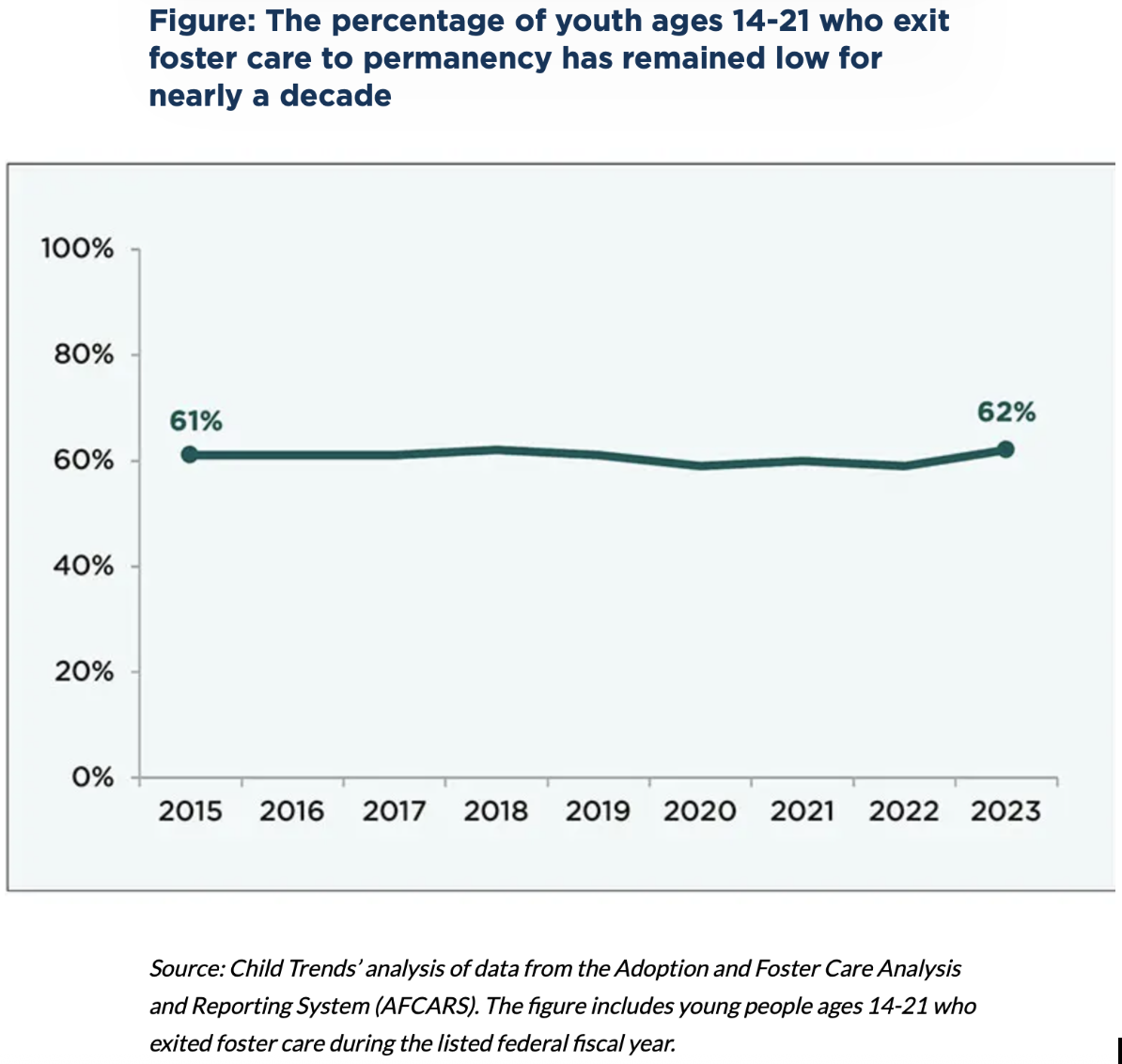
Permanency, including long-term relationships. A repeated theme at the most recent hearing was the benefit for foster youth of lifelong connections with caring adults, and the way the current federal role in supporting them is thin. Analysis by ChildTrends has shown permanency for youth 14-21 steady at just over 60% from 2015 to 2023.
The Themes in the Field: Where There’s Overlap…
These DC themes overlap –but only partially– with recommendations coming from the field.
For example, the recent “Improving Outcomes for Young Adults” book of best practices from American Public Health Services Association (APHSA), Foster Club, and Youth Villages has priorities that include:
Education. It highlights several approaches to boosting higher education attendance by foster youth.
Employment. In particular, the importance of workforce development and specialized career services.
Building lifelong connections. Approaches like family finding and kinship navigation.
Similarly, the Annie E. Casey Foundation’s report “Fostering Youth Transitions 2023” also urged the prioritization of permanent connections and family ties for older and former foster youth.
…And Where There Isn’t
But the field’s full priority list is longer than what Washington is currently signaling.
Several recommendations from Improving Outcomes and Fostering Youth Transitions are notably absent from federal conversations, including:
Increasing funding for the Chafee program. A core ask from advocates — but not one that fits the current fiscal or political environment. Issues like administrative barriers creating unspent ETV vouchers also makes it challenging to see Congress boosting funding without structural changes.
Investing in affordable housing and flexible housing assistance. A top need elevated by transition-age youth, yet largely outside the frame of current congressional discussions. And the Administration has proposed scaling back housing aid for the homeless – a signal of headwinds, not momentum.
Expanding Medicaid eligibility and support through age 26. Widely endorsed in the field and long a bedrock policy commitment, but running counter to the federal direction. H.R. 1 contained substantial Medicaid cuts, which will constrain a financing tool expanding priorities like mental health access.
Both major field reports also recommended greater investment and “redesign” of the Chafee program.
That conversation is not happening in DC. That is likely an outgrowth of two factors.
First is the lack of a simple to explain and unifying vision for older youth policy. Leading with nuance and complexity is a recipe for inaction in Washington, where leaders want to easily explain a bold agenda. What is a simple to explain vision for Chafee redesign?
Second is the buried lede on the “redesign” side of the ledger. When programs struggle from decades of under investment, counter-intuitively it becomes harder to justify boosting them as they are.
A proposal that reconfigures a program has an inherently stronger case for more funds.
The gap between field priorities and federal feasibility is likely to grow as reconciliation and deficit pressures intensify.
What’s Likely
Washington isn’t working from a unified blueprint. There’s no “three-point plan” for older youth that the DC players are using as a first draft.
This is understandable given the scope and variety of needs that older and former foster youth have.
But it means that Washington policymakers are picking and choosing from a long list of ideas, rather than advancing a coherent framework. That dynamic shapes and limits everything that comes next.
A reauthorization of the Chafee program is the most obvious legislative vehicle.
Early conversations point to the Ways and Means Committee as the starting point. Expect modest adjustments rather than a wholesale rethink; laundry list policy agendas tend toward to-do-list policy proposals.
At the same time, work at the White House and HHS to implement the Executive Order is beginning, with a progress report due in six months – a tight turnaround that favors operational changes (technology, data, flexibilities) over broader structural reform.
For stakeholders whose priorities aren’t yet on the Washington radar, the window for advocacy is still open– but not indefinitely.
The most likely outcome is a few (probably useful) tweaks to the Chafee program and perhaps some better technology and data from the EO.
For everyone else: this is the moment to get specific.
When policymakers start drafting, only the recommendations already in front of them tend to make it onto the page. Waiting to respond to Congress will mean reacting to a proposal, not writing it.
What Decision Makers Need to Know
The center of gravity for 2026 child welfare policy is shifting toward older and former foster youth.
That momentum is real, and it’s bipartisan – but it’s also shallow and undeveloped.
For decision makers, two things matter:
The agenda is still fluid and open to shaping.
Congress hasn’t settled on the contours of a Chafee reauthorization, and the Executive Order leaves wide latitude in how agencies interpret “effectiveness” for older youth.
Vision and specificity will shape the outcome.
In the absence of a field-wide roadmap, the ideas that get taken up will be the ones already articulated, costed, and ready for policymakers to lift. Especially if they can cohere as an easy to explain reform vision.
If supporting older youth is your priority, the time to engage is now — before the policy scaffolding sets.