Decoded- Foster Care Decline Pt III
Declining Foster Care Rates Pt. III: States Tell Their Stories
What the states with the biggest drops say drives their decline.
Access it here as a printable PDF
By Laura Radel, Senior Contributor & Brett Greenfield
In the first two parts of this three part series, we examined the substantial recent declines in foster care caseloads nationally and in the eight states whose caseloads have contracted the most, finding varying patterns in the timing and rates of decline.
But the numbers alone can’t tell us what kind of system change is underway.
Here, we examine how the same eight states explain their declining caseloads through public statements, fact sheets, news reports, and blog posts.
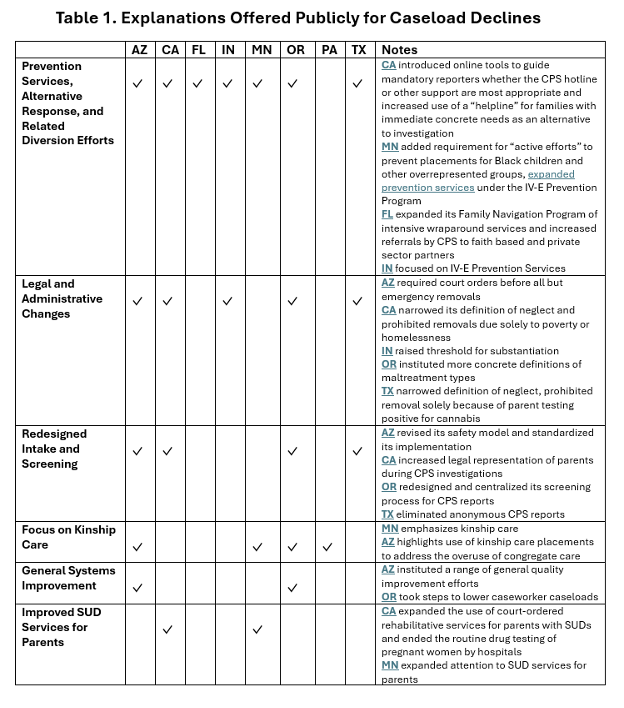
States offer varied explanations for their foster care declines, emphasizing prevention services, narrowed investigatory procedures, increased reliance on kinship care, and other reforms.
How states explain and take credit for changes to their systems may or may not accurately reflect causality.
Without rigorous testing of these claims, the field risks replicating interventions based on their preferred narratives rather than evidence of what actually worked.
These stories states tell are useful. They identify potential drivers and begin to specify how policies and programs might lead to fewer children in foster care.
But when examined critically, considerable room for debate also emerges, with implications for leaders and decision-makers nationwide.
The Explanations
Explanations for declining foster care caseloads fell into six categories. Two of these categories dominated explanations: an increased emphasis on prevention services and legal or administrative changes to how child protection investigations are conducted.
Prevention Services: The Most Common Explanation
Seven of the eight states described expanded prevention services and alternative responses to Child Protective Services (CPS) reports as reducing foster care entries.
These efforts were intended to reduce placements through less invasive family interventions that would keep children safe.
Minnesota instituted a new requirement for “active” (rather than reasonable) efforts to prevent out of home placements for Black children and other groups overrepresented in the child welfare system.
Florida expanded its Family Navigation Program which provides intensive wraparound services, and increased CPS referrals to faith-based and private sector partners offering supportive services without CPS involvement.
Indiana emphasized services offered through its Title IV-E Prevention Program.
California, particularly its largest jurisdiction, Los Angeles County, introduced online tools to guide mandatory reporters on whether to make a CPS hotline call or refer families to other support avenues. The state also expanded a helpline for families with immediate concrete needs, such as for food or housing assistance.
Other states cited more general expansions of prevention efforts.
Legal and Administrative Changes: Narrowing the Front Door
Five of the eight states enacted statutory or regulatory changes to CPS definitions or investigatory procedures that narrowed the “front door” of the child welfare system.
Arizona required investigators to obtain court orders before any but emergency placements.
California narrowed its definition of neglect and prohibited removals solely for poverty or homelessness.
Indiana raised its threshold for substantiating maltreatment.
Oregon instituted more concrete definitions of all maltreatment types to limit ambiguity and variability.
Texas narrowed its definition of neglect and prohibited removal solely based on a parent’s positive drug test for cannabis.
Redesigned Intake and Screening Practices
Four states changed how CPS investigations are conducted.
Arizona redesigned its safety model and standardized implementation statewide.
California increased legal representation for parents during CPS investigations, before removal occurred.
Oregon redesigned its screening process for CPS reports and centralized screenings statewide.
Texas eliminated anonymous CPS reporting.
Focus on Kinship Care
Four states (Arizona, Minnesota, Oregon and Pennsylvania) cited increased emphasis on kinship care as a factor in their declining foster care use.
States did not specify the mechanism, but this could reflect increased reliance on kin as an alternative to foster care placement (often referred to as “hidden foster care”), increased use of relative foster care when removal was necessary, or increased use of guardianships as a foster care exit strategy.
When kin placements are used outside the foster care system, relatives often are ineligible for the financial or non-financial support that comes with being a foster parent, or may qualify for support at lower levels such as through TANF child only payments rather than foster care stipends.
Depending on how states organize and deploy their kinship care efforts, reductions in foster care may provide more support to children to remain closer to their families, or may simply shift financial and social burden from government systems to relatives.
General Systems Improvement: The Catch-All Category
Two states cited broad systems improvement as contributing to caseloads declines.
Oregon pointed to reduced caseloads for case workers as the most prominent element in a series of reforms.
Arizona developed and implemented a supervisory coaching program intended to improve casework quality.
Substance Use Disorder (SUD) Treatment: Addressing Root Causes
California and Minnesota both attributed some of their caseload declines to changes in SUD treatment services for parents.
California increased court-ordered rehabilitation services for both SUD and mental illness. The state also ended the routine drug testing of pregnant women by hospitals, testing only when there was reason to suspect substance use might be impacting the pregnancy.
Minnesota officials cited faster treatment access for parents as a factor in preventing placements, according to news reports on the state’s caseload decrease.
What These Stories Tell – and What They Miss
State explanations for their foster care declines propose factors worth investigating and theories of change worth testing.
But establishing what actually works requires more than accepting agencies at their word.
Rigorous research into causes and effects, informed by state and regional dynamics, is what moves the field forward.
For example, a prominent group of researchers have challenged Indiana’s attribution of its foster care declines to the Title IV-E Prevention Program, arguing that administrative changes are more likely to have driven the reduction.
Similarly, the timing of some states’ declines suggests that changes in practice during the COVID epidemic may have played a significant role.
The deeper question is whether the explanations match what drives foster care placement in the first place.
If the field has previously misidentified risk, then changing definitions or processes could address the problem.
But if factors including parental substance use, mental illness, and intimate partner violence lie behind much of the maltreatment that reaches child welfare agencies, it is less clear that changes that do not directly address these factors can adequately address risk to children.
As policy makers and practice leaders consider changes intended to reduce foster care entry, a key question is how major risk factors facing children will be addressed outside the child welfare system as children are being deflected from it.
Understanding whether foster care declines represent success requires measuring not just how many children avoid foster care, but whether children inside the system — and those diverted from it — are actually safer and better off.
Without that evidence, celebration may be pointing to a signal of future concern rather than past success.
Tool for Action: Essential Questions for Leaders Navigating This Terrain
Our analyses raise key considerations for leaders making decisions in light of ongoing trends related to the number of children in foster care. These are prompts to support your decision-making process.
What can you credibly say about any changes in the number of kids in care based on the dynamics of your specific system and the data you have available?
As services, definitions, or practice change in your system, how are you adapting the outcomes on which you focus, and why?
What are the primary risk factors for the population of children being reported to CPS in a particular system?
How are those risks being addressed within the system compared to outside the system?
What signals will you be watching to know if safety risk rises with increased kinship diversion/ "hidden foster care"?
Re-reports?
Subsequent placements?
Increased fatalities?
Something else?
What systems already exist to monitor those indicators and report on them? What would it cost to expand such systems to provide any additional needed indicators?